

How to Protect Files, Folders, and the Windows Registry with Kernel-Level Access Control
FSBlocker introduces kernel-level application-based file access control designed to protect critical data from ransomware and unauthorized modification. By intercepting file system calls and enforcing configurable policies, it prevents malicious encryption attempts and safeguards backup repositories, helping organizations strengthen cyber resilience and ensure the integrity of their recovery infrastructure.
Cristie Software announces FSBlocker application-based file access control.
# ## News: Cristie Software announces FSBlocker, a kernel-level driver for application-based access control of critical data.
Cristie Software has launched FSBlocker, a kernel-level driver providing application-based access control for Windows systems. It prevents unauthorized modification or deletion of critical data, including backup stores. The utility intercepts file system calls to block malicious encryption attempts, offering a robust defense against ransomware.
What is Clean Room Recovery in Cybersecurity?
Clean Room recovery provides a secure, isolated environment to safely test and validate system recoveries after a cyberattack. By preventing reinfection from hidden threats like ransomware, it ensures recovery points are clean and reliable—making it an essential part of modern cybersecurity and business continuity strategies.
Turn DRaaS into a recovery certified solution with Continuous Recovery Assurance
Transform your DRaaS offering from basic protection into a fully certified recovery solution with Cristie’s Continuous Recovery Assurance. Automate non-disruptive recovery testing, deliver proof of recoverability, and reduce downtime risks—all while offering a premium, chargeable service that builds trust and resilience for your customers.
Cristie Software presenta System Recovery PBMR para Dell Technologies PowerProtect Data Manager

# ## News: Cristie Software Launches PBMR for Dell PowerProtect
Cristie Software has announced the general availability of System Recovery PBMR for Dell Technologies PowerProtect Data Manager. This integration enables automated bare machine recovery (BMR) to physical, virtual, or cloud targets, featuring Continuous Recovery Assurance to verify system bootability within isolated clean room environments for enhanced cyber resilience.
Fusión de Cohesity y Veritas: Por qué Cristie Software BMR permite la recuperación automatizada a gran escala

Cohesity Veritas Merger: Why Cristie Software BMR Unlocks Automated, Large-Scale Recovery Introduction: A New Era for Enterprise Backup and Recovery The merger of Cohesity and Veritas marks a defining moment in the enterprise backup and recovery market. By combining Cohesity’s modern, cloud-native innovation with Veritas’ decades of market presence, Cohesity Veritas now represents one of the largest data protection companies in the world. While both platforms offer powerful backup and recovery features, many enterprises face a common challenge: how to recover entire server estates quickly and at scale after a disaster. This is where Cristie Software’s Bare Machine Recovery (BMR) solutions—CoBMR for Cohesity and CBMR for Veritas—play a transformative role. The Cohesity–Veritas Merger at a Glance The merger brings together: Cohesity DataProtect: a cloud-ready, scalable backup and recovery platform. Veritas NetBackup: a trusted enterprise backup system with global adoption. Together, they offer customers a unified choice of solutions for hybrid and multi-cloud environments. Backup Strengths of Cohesity and Veritas Cohesity DataProtect: Modern, Scalable Data Protection Cohesity is known for: Unified data management. Cloud-native integration. Rapid backup and restore of VMs, databases, and applications. Veritas Backup: Traditional Strengths and BMR Capabilities Veritas NetBackup has a BMR feature, but its automation capabilities are limited. Enterprises often find it difficult to scale BMR across large, diverse server estates without manual intervention. The Bare Machine Recovery Challenge Why BMR Is Essential for Enterprise IT Bare Machine Recovery (BMR) restores entire systems from scratch—including the operating system, applications, and configurations. It’s crucial for: Disaster recovery after ransomware or hardware failure. Cloud migrations. Hardware refresh projects. Limitations of Veritas Native BMR While Veritas includes BMR, it lacks the automation depth needed to handle large-scale recovery across hundreds or thousands of physical servers. This gap creates risks in disaster recovery planning. Cristie Software’s Advanced BMR Solutions Cristie CoBMR for Cohesity DataProtect CoBMR integrates directly with Cohesity backups, adding full-system recovery and hardware-independent restores to physical, virtual, or cloud platforms. Cristie CBMR for Veritas NetBackup CBMR extends Veritas NetBackup by providing advanced automation and orchestration for bare machine recovery, scaling to enterprise server estates. The Key Advantage: Automation at Scale Automating Full Server Estate Recoveries Cristie BMR solutions allow IT teams to automate the recovery of entire physical server estates—saving countless hours during large-scale incidents. Consistency, Speed, and Reduced Human Error Automated workflows ensure: Faster recovery times. Reduced manual effort. Consistent and repeatable outcomes. Benefits of Adding Cristie BMR to Cohesity Veritas Environments Faster RTOs and Greater Flexibility – Get critical systems online within hours, not days. Large-Scale Disaster Recovery for Physical Servers – Recover entire estates in parallel with minimal manual steps. Seamless Multi-Platform Recovery – Restore workloads across physical, virtual, and cloud platforms. Real-World Use Cases Enterprise Data Center Recovery After Ransomware – Rapid restoration of hundreds of servers simultaneously. Large-Scale Hardware Refresh or Cloud Migration – Move workloads seamlessly between platforms. Automated Compliance Testing of DR Plans – Prove recovery capabilities for audits with scheduled, automated testing. Why Cristie BMR Complements the Cohesity Veritas Merger Closing the Automation Gap in Veritas BMR While Veritas offers BMR, Cristie’s CBMR adds automation that scales for modern enterprise needs. Strengthening Cohesity Veritas for Hybrid and Multi-Cloud IT By combining Cohesity’s cloud innovation, Veritas’ market presence, and Cristie’s BMR automation, enterprises achieve a future-proof recovery strategy. FAQs on Cristie BMR with Cohesity and Veritas Q1: Does Veritas already include BMR?A1: Yes, Veritas NetBackup includes basic BMR, but it lacks automation for large-scale recovery. Cristie CBMR fills this gap. Q2: How does CoBMR enhance Cohesity DataProtect?A2: CoBMR enables bare metal recovery from Cohesity backups, with full automation and hardware independence. Q3: Can Cristie BMR solutions recover to cloud platforms?A3: Yes, both CoBMR and CBMR support recovery to cloud, physical, and virtual environments. Q4: Is Cristie BMR suitable for large enterprises?A4: Absolutely—Cristie solutions are designed to automate recovery of large physical server estates at scale. Q5: Does Cristie BMR support automated recovery testing?A5: Yes, automated recovery testing ensures compliance and verifies that DR plans will work when needed. Conclusion: Future-Proofing Recovery with Cristie Software The Cohesity–Veritas merger creates a new force in data protection. Yet, for enterprises with complex infrastructures, automation and scalability in bare machine recovery remain critical. By integrating Cristie CoBMR for Cohesity and Cristie CBMR for Veritas, organizations gain the ability to automate large-scale recovery, reduce downtime, and ensure business continuity in even the most demanding disaster scenarios. Learn more about Cristie Software Bare Machine Recovery.
Por qué añadir Cristie CoBMR a Cohesity Backup cambia las reglas del juego de la recuperación de sistemas

Why Adding Cristie CoBMR to Cohesity Backup is a Game-Changer for Data Recovery Introduction to Cohesity Backup In today’s digital-first business world, data is one of the most valuable assets an organization owns. Protecting it with robust backup and recovery strategies is no longer optional—it’s a necessity. Cohesity Backup has emerged as a market leader in modern data protection, offering enterprises a unified platform that simplifies backup management, reduces costs, and ensures fast recovery from disruptions. The Importance of Data Protection in Modern IT With the rise of cyberattacks, ransomware, hardware failures, and natural disasters, organizations can’t afford prolonged downtime. A strong backup solution ensures that critical applications and workloads can be restored quickly and securely. Key Features of Cohesity Backup Centralized Data Management: Simplifies backup, recovery, and long-term retention. Scalable Architecture: Easily expands as organizations grow. Cloud-Native Integration: Supports hybrid and multi-cloud deployments. Rapid File and VM Recovery: Enables fast restoration of files, virtual machines, and databases. While these capabilities are impressive, there’s one critical area where organizations often need more: bare machine recovery. The Challenge: Recovery Beyond File and VM Restore Limitations of Standard Backup and Recovery Although Cohesity Backup excels at restoring files, applications, and virtual machines, it does not inherently provide full bare metal recovery (BMR). In catastrophic failures—such as a total system loss—organizations need a way to recover entire machines from scratch. Why Organizations Need Bare Machine Recovery Bare machine recovery ensures that IT teams can rebuild entire systems, including the operating system, applications, and configurations, onto new hardware or virtual platforms—a critical requirement in disaster recovery scenarios. Introducing Cristie CoBMR for Cohesity What is Cristie CoBMR? Cristie Software’s CoBMR (Cohesity Bare Machine Recovery) is an advanced solution that extends the functionality of Cohesity Backup by enabling full system recovery to physical, virtual, or cloud environments. How CoBMR Integrates Seamlessly with Cohesity Backup Works directly with existing Cohesity backups. Adds bare metal restore capabilities without requiring changes to backup policies. Provides a user-friendly recovery wizard for fast orchestration. Benefits of Adding Cristie CoBMR to Cohesity Backup Rapid Bare Metal Recovery to Any Hardware or Virtual Platform Restore complete systems to dissimilar hardware, virtual machines, or cloud platforms—perfect for hardware upgrades or unexpected failures. Faster Recovery Times for Critical Systems Downtime costs money. CoBMR dramatically reduces RTOs (Recovery Time Objectives), allowing organizations to get back online faster. Hardware Independence for Maximum Flexibility CoBMR removes dependency on original hardware. This means an organization can recover workloads onto different physical servers, VMware, Hyper-V, or cloud-based instances. Automated Recovery Testing for Compliance and Assurance Regular automated testing ensures recovery plans actually work, helping organizations meet compliance standards and audit requirements. Enhanced Disaster Recovery and Business Continuity When combined with Cohesity Backup, CoBMR provides a holistic disaster recovery strategy, ensuring both data and entire systems are recoverable in any scenario. Cristie CoBMR Real-World Use Cases Recovery After a Cyberattack or Ransomware Incident – Quickly rebuild compromised machines from clean backups. Migration to New Hardware or Cloud Environments – Move workloads seamlessly between platforms. Restoring Legacy Systems – Recover older systems without compatibility headaches. Step-by-Step: How CoBMR Works with Cohesity Backup Backup Capture with Cohesity – Cohesity Backup stores system data and configurations. Recovery Orchestration with CoBMR – CoBMR takes Cohesity backups and rebuilds the full system environment. Testing and Validation – Automated testing ensures the recovery works when it matters most. Why Choose Cristie CoBMR with Cohesity Backup Over Alternatives Competitive Advantages Seamless integration with Cohesity Hardware-agnostic recovery Proven reliability and security Cost-Effectiveness and ROI By minimizing downtime and maximizing recovery flexibility, CoBMR delivers strong ROI while ensuring critical business operations remain uninterrupted. FAQs About Cohesity Backup and Cristie CoBMR Q1: What is the main difference between Cohesity Backup and CoBMR?A1: Cohesity Backup protects data, while CoBMR extends functionality to enable bare machine recovery of entire systems. Q2: Can CoBMR recover to cloud environments?A2: Yes, CoBMR supports recovery to both physical and virtual platforms, including cloud-based instances. Q3: Is additional infrastructure required to use CoBMR with Cohesity Backup?A3: No, CoBMR integrates directly with existing Cohesity environments without requiring additional backup changes. Q4: How fast is the recovery process using CoBMR?A4: Recovery is significantly faster than manual rebuilds, with minimized downtime for critical workloads. Q5: Does CoBMR support compliance and audit requirements?A5: Yes, automated recovery testing provides validation for compliance frameworks. Q6: Who benefits most from adding CoBMR to Cohesity Backup?A6: Enterprises that require fast, reliable, and flexible system recovery across diverse environments. Conclusion: Future-Proof Your Backup Strategy with Cohesity and Cristie CoBMR While Cohesity Backup offers world-class protection for modern enterprises, adding Cristie CoBMR bare machine recovery ensures organizations can restore not only data but entire systems—anywhere, anytime. The combination delivers unmatched resilience, business continuity, and peace of mind in the face of disruptions. 🔗 Learn more about Cristie Software CoBMR for Cohesity
Recuperación del sistema con Cristie Software: su guía definitiva para una recuperación del sistema rápida y fiable

System Recovery with Cristie Software: Ultimate 2025 Guide to Fast, Reliable System Recovery Introduction to System Recovery with Cristie Software In today’s always-on digital economy, system downtime can mean the difference between profit and loss. System Recovery with Cristie Software has emerged as one of the most dependable solutions for restoring business-critical systems swiftly and securely. Whether your organization is recovering from hardware failure, cyberattacks, or planned migrations, Cristie Software provides the tools to ensure minimal disruption and maximum resilience. What is Cristie Software? Cristie Software is a global leader in system recovery, migration, and cloning technology. Established over two decades ago, the company has specialized in automating bare metal recovery (BMR) across physical, virtual, and cloud environments. Their solutions integrate seamlessly with major backup platforms such as Rubrik, Cohesity, Dell Technologies and IBM — allowing organizations to restore complete systems from backup images in record time. Why System Recovery Matters in 2025 With hybrid workforces, cloud dependencies, and increasingly sophisticated cyber threats, businesses can’t afford prolonged downtime. System recovery ensures that when disaster strikes—be it ransomware, a data center outage, or hardware malfunction—operations resume quickly without data loss or compliance breaches. Key Features of Cristie Software for System Recovery Automated Bare Metal Recovery (BMR) Cristie Software automates the restoration of an entire operating system—along with applications, settings, and configurations—directly to new hardware or virtual machines. This eliminates the need for time-consuming manual setups. Cross-Platform and Hardware Independence One of Cristie’s strongest capabilities is hardware-independent recovery. Whether you’re moving from Dell to HP servers or migrating from on-premise to cloud, Cristie adapts without compatibility issues. Integration with Major Backup Solutions Cristie acts as a powerful add-on to existing backup software. Instead of replacing your current setup, it enhances it—offering recovery capabilities that most backup tools lack. Secure, Encrypted Recovery Processes With end-to-end encryption, Cristie ensures that sensitive business data remains protected throughout the recovery process, meeting strict compliance regulations like GDPR and HIPAA. How Cristie Software Works for System Recovery Cristie Software’s recovery process is designed to be as hands-off as possible for IT teams, while still giving administrators control over key settings. Here’s a breakdown of how it works: Step-by-Step Recovery Workflow Step 1: Backup & System Imaging The recovery process starts with creating a full system image—a snapshot of the operating system, installed applications, configurations, and data. Cristie integrates with your existing backup software to pull this image directly, ensuring no disruption to your current backup strategy. Step 2: Preparing the Recovery Environment Once the system image is ready, Cristie prepares the target environment. This could be: A new physical server A virtual machine (VM) A cloud-hosted infrastructureThe software injects the necessary drivers and configurations for compatibility. Step 3: Restoring the System Cristie’s bare metal recovery engine deploys the system image onto the target hardware or VM. Because of its hardware-independent design, it works across vendors and platforms without manual reinstallation. Step 4: Post-Recovery Validation After the restoration is complete, Cristie automatically validates the system, ensuring that all applications run correctly, network settings are intact, and data integrity is maintained. Benefits of Using Cristie Software for System Recovery Reduced Downtime for Businesses Downtime costs money—often thousands of dollars per hour. Cristie’s automation and speed drastically reduce recovery times, letting businesses return to normal operations quickly. Simplified Disaster Recovery Planning By integrating with existing backup tools and providing hardware-independent recovery, Cristie simplifies disaster recovery (DR) planning, reducing both complexity and cost. Flexibility Across IT Environments Cristie works in hybrid setups—on-premise, cloud, and virtualized—making it ideal for businesses undergoing digital transformation. Cristie Software’s Supported Platforms and Environments Windows, Linux, and AIX Support Cristie supports a wide range of operating systems, from Windows Server editions to Linux distributions and even IBM AIX, making it suitable for enterprise-grade deployments. Physical, Virtual, and Cloud Environments Whether your infrastructure is: A legacy on-premises data center A VMware or Hyper-V virtualized environment A cloud platform such as AWS or AzureCristie can adapt and recover systems in any scenario. Comparing Cristie Software with Other System Recovery Solutions Feature Comparison Table Feature Cristie Software Traditional Backup Tools Other Recovery Software Bare Metal Recovery Hardware Independence Partial Multi-Platform Support Partial Partial Backup Integration Automated Validation Encryption Partial Partial Pricing and Licensing Considerations Cristie Software offers flexible licensing models, including perpetual and subscription-based options. Costs vary depending on the number of systems protected and the level of support chosen. Best Practices for System Recovery with Cristie Software Regular Testing and Recovery Drills Performing test recoveries ensures your team is prepared and helps identify issues before a real disaster occurs. Maintaining Updated Recovery Images Keeping system images updated ensures that your recovery process restores the latest system state. Security Measures During Recovery Always use encrypted recovery channels to prevent data leaks during restoration. Real-World Use Cases of Cristie Software Enterprise Disaster Recovery Large organizations rely on Cristie for quick recovery of mission-critical systems, reducing downtime from days to hours. Data Center Migrations Cristie enables seamless migrations between data centers or from physical to virtual infrastructure. Cloud Failover Scenarios With Cristie, organizations can shift workloads to the cloud temporarily during outages. Common Challenges and How Cristie Software Solves Them Hardware Compatibility Issues Cristie’s hardware-independent technology eliminates compatibility concerns when restoring to new hardware. Time-Consuming Manual Restorations Automation allows full system recovery without the need to manually reinstall OS, drivers, and applications. Future of System Recovery with Cristie Software AI and Automation in Recovery Processes Cristie is actively exploring AI-driven recovery, predicting potential failures before they occur and triggering automated restorations. Expanding Cloud and Hybrid Recovery Capabilities Expect more native integrations with leading cloud providers and improved hybrid recovery workflows. FAQs About System Recovery with Cristie Software Q1: Can Cristie Software recover a system to completely different hardware?Yes, Cristie supports full hardware independence, allowing recovery to any supported hardware platform. Q2: Does Cristie Software work with my existing backup solution?Yes, it integrates with major backup platforms such as Rubrik, Cohesity,
Recuperación Bare Metal frente a copia de seguridad: Por qué es importante la velocidad de recuperación
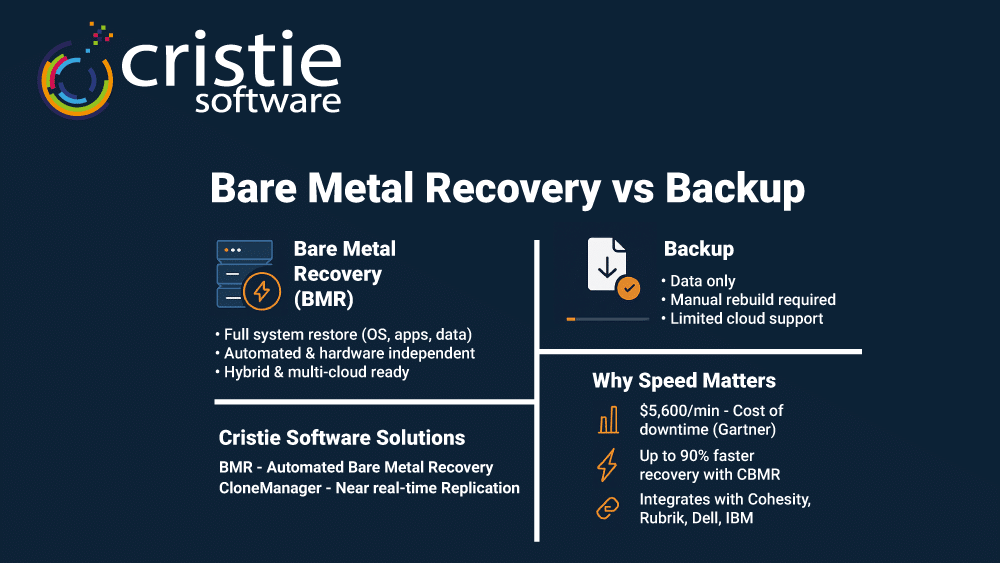
Bare Metal Recovery vs. Backup: Why Recovery Speed Matters When IT systems fail, every second of downtime costs money, disrupts operations, and impacts customer trust. Traditional backup solutions can protect your data, but they often leave you with the lengthy task of rebuilding entire systems from scratch. This is where bare metal recovery (BMR) changes the game. In this article, we’ll break down the differences between bare metal recovery vs. backup, explain why recovery speed is a critical KPI for business continuity, and show how Cristie Software’s solutions help enterprises minimize downtime. What Is Bare Metal Recovery? Bare metal recovery is the process of restoring an entire system — including the operating system, applications, data, and configuration — directly onto new hardware, virtual machines, or cloud environments. Unlike traditional backup, which focuses only on files or data, BMR ensures that a system is fully operational after recovery. Key Benefits of Bare Metal Recovery: Minimal Downtime: Restore systems in minutes, not days. Hardware Independence: Recover to dissimilar hardware or virtual platforms. Integration with Backup Vendors: Seamlessly integrates with Cohesity, Rubrik, Dell Technologies, and IBM. Cloud Flexibility: Recover to on-premises, cloud, or hybrid environments. Pro Tip: If you use a backup solution from Cohesity, Rubrik, Dell or IBM we have a BMR solution that will seamlessly integrate with your existing backup environment. Alternatively, Cristie CBMR is purpose-built standalone tool for automated bare metal recovery across physical, virtual, and cloud workloads, ensuring rapid restoration with minimal human intervention. What Is Backup? Backup solutions are designed to protect data, not full systems. They create copies of files, folders, or application data that can be restored in case of loss or corruption. While essential for disaster recovery, backups have limitations: You must manually reinstall the operating system. Drivers, configuration, and applications must be rebuilt. Full recovery often takes hours or even days. Backups are valuable for granular file restoration, but for mission-critical workloads where downtime is unacceptable, backups alone are not enough. Bare Metal Recovery vs. Backup: Key Differences The table below summarizes the main distinctions between traditional backup and bare metal recovery: Feature Backup Bare Metal Recovery (BMR) Recovery Time Hours to days Minutes to hours System State Not included Full OS, apps, and configuration Hardware Dependence Yes No – hardware independent Automation Limited Fully automated with BMR Cloud Ready Often limited Hybrid and multi-cloud support With CBMR, businesses can transform what was once a manual, time-consuming process into a fully automated recovery workflow. Why Recovery Speed Matters for Business Continuity Downtime is one of the most expensive risks facing enterprises today: Financial loss: Gartner estimates downtime costs $5,600 per minute for large organizations. Compliance risks: Regulations such as GDPR, HIPAA, and DORA demand rapid recovery to maintain operational continuity and data integrity. Reputational damage: Delays in system recovery impact customer confidence and service delivery. Bare metal recovery directly addresses these challenges by accelerating recovery and reducing human error during high-pressure incidents. How Cristie Software Delivers Faster Recovery Cristie Software specializes in solutions that enable IT teams to recover entire systems with speed and precision: CBMR (Cristie Bare Machine Recovery) Automated bare metal recovery for physical, virtual, and cloud environments. Integration with major backup vendors like Cohesity, Rubrik, Dell Technologies, and IBM. Hardware-independent recovery, reducing infrastructure constraints. Learn more about CBMR → CloneManager (System Replication and Migration) Continuous system replication with near real-time synchronization. Ideal for disaster recovery sites and cloud migration. Automates failover to standby systems for business continuity. Explore CloneManager → By combining CBMR for recovery with CloneManager for replication, organizations can achieve a comprehensive disaster recovery strategy that minimizes downtime and ensures resilience. FAQs About Bare Metal Recovery To help IT decision-makers, here are the most common questions about bare metal recovery vs. backup: What is the difference between bare metal recovery and backup? Bare metal recovery restores an entire system — OS, applications, data — to a new machine. Backup restores only files or data, often requiring manual system rebuilding. Does Cristie CBMR integrate with Cohesity or Rubrik? Yes. CBMR integrates seamlessly with Cohesity, Rubrik, Dell Technologies, and IBM, enabling automated system recovery using your existing backup infrastructure. How long does a bare metal recovery typically take? Depending on system size and infrastructure, CBMR can restore systems in minutes to a few hours, compared to the days required for manual rebuilds. Conclusion: Don’t Just Back Up — Recover Smarter Backups are essential, but recovery speed is what drives true business resilience. Bare metal recovery with Cristie CBMR ensures your systems are operational in minutes, not days, while CloneManager keeps your environments synchronized and ready for failover. 👉 Request a demo today and see how Cristie Software can transform your recovery strategy, reduce downtime, and protect your enterprise against disruption.
Rubrik BMR frente a Rubrik + Cristie Software RBMR: ¿cuál es la mejor estrategia de recuperación Bare Metal?
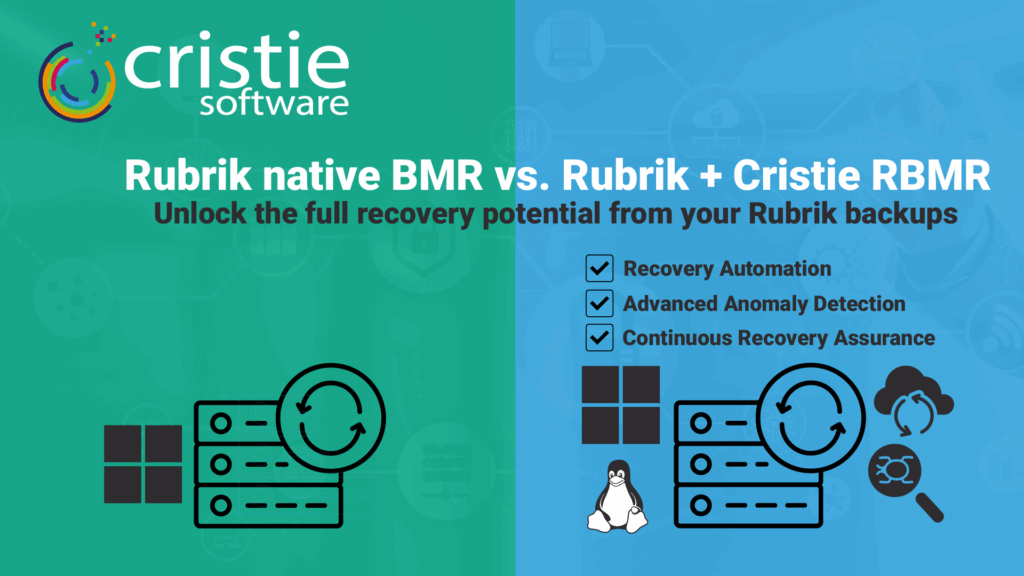
Rubrik BMR vs. Rubrik + Cristie Software RBMR: What’s the Best Bare Metal Recovery Strategy? Introduction: Why Bare Metal Recovery Still Matters In today’s hybrid IT environments, the ability to recover entire systems from scratch—regardless of hardware or platform—remains a critical capability. Bare Metal Recovery (BMR) ensures organizations can bounce back from cyberattacks, hardware failures, or data center disasters with minimal disruption. Rubrik, a leader in cloud data management, offers native BMR capabilities. But for organizations seeking greater flexibility, platform support, and enhanced system recovery workflows, integrating Cristie Software RBMR with Rubrik can provide a powerful upgrade over native Rubrik BMR. What is native Rubrik BMR? Rubrik’s built-in Bare Metal Recovery feature allows administrators to back up and restore entire systems, including the operating system, system state, and configuration. It’s designed primarily for Windows workloads and integrates with Rubrik’s policy-driven data protection framework. Key Features of Rubrik BMR: Uses Rubrik image level backup for Windows systems Automated backup policies for system state Integration with Rubrik’s SLA domains Snapshot-based recovery approach Limitations of Rubrik BMR: Primarily limited to Windows OS WinPE boot images must be created manually No native Linux support – uses REAR (Relax and Recovery) for BMR workflows External imaging tools are required for Unix support Must connect to Rubrik Backup for recovery Less flexibility for dissimilar hardware or VM-to-physical (and vice versa) restores No standalone recovery boot environment Introducing Cristie RBMR for Rubrik: What Does It Add? Cristie Software’s RBMR (Rubrik Bare Metal Recovery) is purpose-built to extend Rubrik’s recovery capabilities with full support for both Windows, Linux, Solaris and AIX systems, wider deployment flexibility, and granular control over the recovery process. What RBMR Adds to Rubrik: ✅ Support for Windows AND Linux, Solaris & AIX systems ✅ User friendly GUI all cross platform BMR functions controlled from a single intuitive interface ✅ Dissimilar hardware recovery, including virtual to physical and cloud to on-prem scenarios ✅ Continuous Recovery Assurance automatic clean room recovery verification every time a new backup job completes ✅ Automated bootable recovery ISO creation (fully scriptable) ✅ Recovery to VMware, Hyper-V, physical, and cloud platforms ✅ Pre- and post-recovery scripting for automation ✅ Fast, consistent Recovery Time Objectives (RTOs) Key Differences: Rubrik BMR vs. Rubrik + RBMR Feature / Capability Rubrik BMR Only Rubrik + Cristie RBMR OS Support Windows only Windows & Linux/Unix/AIX Hardware Flexibility Limited Full dissimilar hardware support Cloud Recovery Partial Fully supported (multi-cloud) Standalone Boot Environment No Yes (bootable ISO/USB/PXE) Automation / Scripting Limited Extensive Recovery Time Performance Basic Optimized & consistent Enterprise Integration Native only Enhanced with RBMR tools Continuous Recovery Assurance No Yes Single GUI for all platforms No Yes Reporting & Audit Trails Basic Detailed recovery logs & reports Use Case Scenarios Where Cristie Software RBMR Excels Cross-Platform Disaster RecoveryRecover a Linux-based server backed up with Rubrik to a completely new VM or physical host—even in the cloud. Hardware Refreshes & System MigrationSeamlessly migrate workloads to new hardware platforms without OS reinstallation or reconfiguration. Cyber Recovery PlaybooksIntegrate RBMR into ransomware response strategies for complete system rollback with known-good states. Hybrid Cloud DeploymentsRecover systems from Rubrik to AWS, Azure, or other cloud platforms using Cristie’s platform-agnostic tooling. Why IT Leaders Choose Cristie RBMR with Rubrik Rubrik provides an excellent foundation for data protection, but when full system recovery across diverse environments is a requirement, Cristie RBMR elevates the solution. The result is faster, more flexible recovery that aligns with modern IT needs—including cybersecurity readiness, hybrid operations, and minimal downtime. Cristie Software has over 3 million systems protected worldwide, and RBMR has been developed to meet enterprise-grade requirements, including compliance, auditability, and platform diversity. “We use Cristie RBMR with Rubrik to recover systems in under 15 minutes—even across platforms. It’s a game-changer for our DR strategy.”— Enterprise IT Manager, Healthcare Sector Rubrik Integration Made Simple RBMR integrates directly with Rubrik’s backup data. The architecture ensures minimal overhead, and recovery ISO creation can be fully automated and managed centrally. No extra backup process is required—Cristie RBMR reads from Rubrik’s native image backups and builds on top of them. Supported Platforms: Operating Systems: Windows Server (2012–2022), RHEL, CentOS, Ubuntu, SUSE, Debian, Solaris, AIX Targets: Physical servers, VMware, Hyper-V, Nutanix, AWS, Azure, Google Cloud Links to further RBMR information Cristie RBMR Product Overview How Cristie Integrates with Rubrik Cristie System Recovery Solutions Why Choose Cristie Software How It Works: Cristie Rubrik Bare-metal Recovery (RBMR) for Linux/Unix Hosts Final Thoughts: Rubrik + Cristie RBMR Better Together While native Rubrik BMR tools provide good basic protection for Windows systems, Cristie RBMR turns Rubrik into a comprehensive, enterprise-ready disaster recovery solution—with true platform independence and rapid recovery built in. For IT leaders seeking to meet demanding SLAs, support mixed environments, or build robust cyber-resilient infrastructure, Cristie RBMR is the missing piece. Looking to unlock full recovery potential from your Rubrik backups? ▶️ Explore Cristie RBMR now or Book a demo with our team to see how it can streamline your system recovery strategy.
¿Qué es la recuperación bare metal o bare machine recovery?
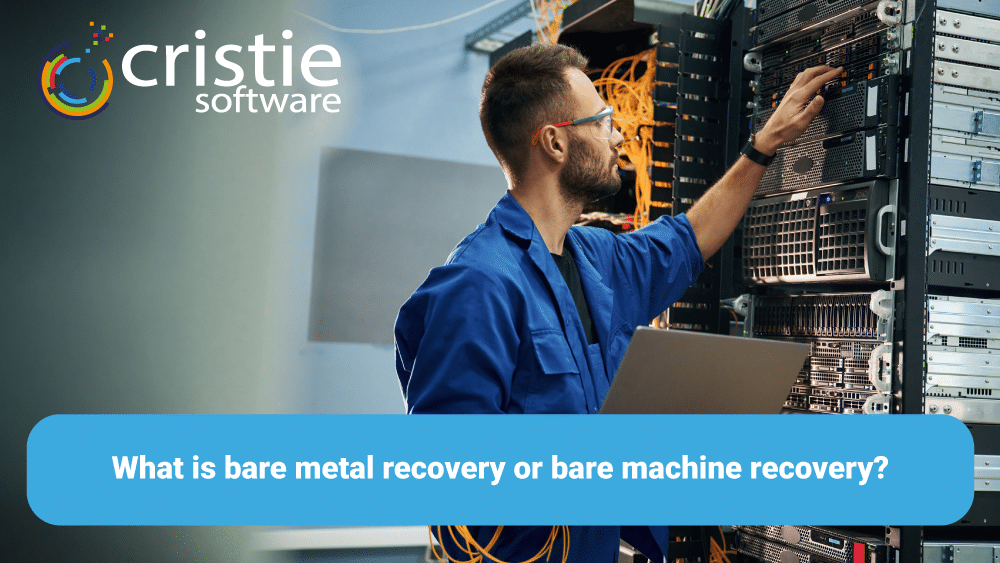
¿Qué es la recuperación bare metal o bare machine recovery? Los términos "bare metal recovery" y "bare machine recovery" hacen referencia al proceso de restaurar un sistema informático -incluidos el sistema operativo, las aplicaciones y los datos- en un hardware nuevo o borrado. Aunque hoy en día suelen utilizarse indistintamente, sus orígenes y casos de uso revelan sutiles diferencias y una evolución acorde con los cambios en los entornos informáticos de las empresas. Origen y evolución de "Bare Metal Recovery" 1 - Primeros usos (década de 1990 - principios de la década de 2000) El término "bare metal recovery" (BMR) surgió en la década de 1990, cuando las TI empresariales empezaron a alejarse del hardware propietario y a acercarse al hardware estandarizado y básico. La expresión se refiere metafóricamente a la restauración de un sistema a un chasis "metálico" desnudo, es decir, una máquina física sin sistema operativo ni software instalado. Inicialmente, BMR se asociaba estrechamente con: Recuperación de desastres para servidores físicos Soluciones de copia de seguridad del sistema en entornos Unix y Windows Centros de datos locales con poca o ninguna virtualización Proveedores como Veritas, IBM y Symantec empezaron a integrar funciones BMR en sus suites de copia de seguridad empresarial para ofrecer una restauración completa del sistema, no sólo una recuperación a nivel de archivos. Veritas Technologies LLC posee una marca comercial para "Bare Metal Restore™", que es un término menos común vinculado al acrónimo BMR. Aparición de "Bare Machine Recovery" 2 - Un giro de Microsoft (década de 2000) El término "bare machine recovery" apareció de forma más prominente en la documentación de Microsoft, especialmente en entornos Windows Server. Describía un concepto similar: la capacidad de recuperar un sistema en una máquina sin software instalado. Sin embargo, el uso de "máquina" en lugar de "metal" se debió probablemente a: Un deseo de una terminología más fácil de usar Un enfoque en la imagen lógica del sistema en lugar del hardware físico Diferenciación de la terminología Unix/Linux Ejemplos: Windows Complete PC Backup and System Image Recovery de Microsoft en Windows Server 2008 utilizaba la expresión "máquina desnuda". Windows Deployment Services y las herramientas de System Center también hacían referencia a "bare machine restore". Uso moderno: intercambiables, pero no siempre idénticos Hoy en día, la recuperación de máquina desnuda es el término más utilizado y reconocido en los ecosistemas de protección de datos comerciales y de código abierto. Lo utilizan proveedores líderes como: Rubrik, Cohesity, Dell Technologies e IBM, que ofrecen herramientas BMR de Cristie Software integradas con sus soluciones de copia de seguridad o junto a ellas. También se menciona mucho en la documentación relacionada con la recuperación ante desastres, la ciberresiliencia y la clonación de sistemas. La recuperación de máquina desnuda todavía puede aparecer en contextos de Microsoft o en materiales heredados, pero se utiliza con menos frecuencia en entornos multiplataforma modernos. Resumen de diferencias Término Uso principal Contexto Origen Uso moderno Recuperación de metal desnudo Unix/Linux y multiplataforma TI empresarial (década de 1990) Término estándar en todas las plataformas Recuperación de máquina desnuda Documentación de Microsoft centrada en Microsoft/Windows (década de 2000) Menos común; uso heredado Por qué la recuperación de metal desnudo es importante para los líderes de TI Comprender estos términos es esencial al especificar las capacidades de recuperación del sistema, especialmente al evaluar soluciones para: Entornos híbridos y de múltiples nubes Cumplimiento normativo y preparación para la ciberseguridad Planificación de la continuidad del negocio Soluciones modernas como BMR de Cristie Software admiten una verdadera recuperación bare metal en plataformas físicas, virtuales y en la nube, lo que garantiza que los sistemas se puedan recuperar de forma rápida y segura, independientemente del entorno. Cristie ofrece soluciones BMR diseñadas para integrarse perfectamente con las plataformas de copia de seguridad de Rubrik, Cohesity, Dell Technologies e IBM, ampliando las capacidades de recuperación de estas plataformas para incluir la recuperación completa del sistema a hardware diferente, o a plataformas físicas, virtuales o en la nube alternativas. Además, Cristie Software CBMR se ofrece como una solución independiente de recuperación de sistemas BMR. Llamada a la acción ¿Busca preparar para el futuro su estrategia de recuperación de desastres? Explore las soluciones de recuperación de sistemas de Cristie Software para ver cómo la recuperación de metal desnudo puede reducir el tiempo de inactividad, apoyar el cumplimiento normativo y aumentar su resiliencia cibernética en cualquier plataforma. Póngase en contacto con el equipo de Cristie Software si desea mejorar la recuperación y replicación de sistemas dentro de su organización, o para obtener más información sobre la replicación de sistemas y nuestra integración de recuperación de sistemas con las principales soluciones de copia de seguridad de proveedores como IBM, Dell Technologies, Rubrik y Cohesity. Por último, descubra cómo estamos ayudando a otras empresas a modernizar la recuperación de sistemas en nuestras páginas de casos de uso.
Ciberseguridad farmacéutica: Por qué nunca ha habido tanto en juego en el Reino Unido y Europa
Ciberseguridad farmacéutica en el Reino Unido y Europa: Por qué nunca ha habido tanto en juego La encrucijada de la ciberseguridad farmacéutica: Retos y riesgos Las empresas farmacéuticas del Reino Unido y Europa se enfrentan a una crisis de ciberseguridad. Con grandes almacenes de propiedad intelectual, datos confidenciales de pacientes y complejas cadenas de suministro digitales, el sector es un objetivo lucrativo para los actores de amenazas. Principales retos de la ciberseguridad en el sector farmacéutico: Robo de propiedad intelectual y violación de datos: Los datos confidenciales de I+D y los resultados clínicos son objetivos clave. Cadenas de suministro complejas: La dependencia de laboratorios y contratistas externos aumenta la exposición al riesgo. IoT y dispositivos conectados: Los equipos de laboratorio inteligentes y los sensores médicos amplían la superficie de ataque. Presiones de cumplimiento: Las normativas GDPR, DORA y MHRA exigen una sólida protección de datos y una preparación auditable para la recuperación. Tiempo de inactividad operativa: Los incidentes cibernéticos pueden detener la fabricación de medicamentos, retrasar los ensayos y poner en riesgo la seguridad de los pacientes. Ataques en el mundo real: La ciberseguridad farmacéutica en la línea de fuego 🧬 Junio de 2024 - Un ataque de ransomware a Synnovis afecta a los hospitales londinenses Un ataque de ransomware a Synnovis -socio de diagnóstico de varios NHS Trusts- paralizó las pruebas de patología, afectando a cirugías y atención de urgencias en todo Londres. La banda cibernética Qilin publicó posteriormente 400 GB de datos robados de pacientes y laboratorios, lo que la convierte en una de las brechas sanitarias más perturbadoras del Reino Unido hasta la fecha. 🦠 Abril de 2025 - ResolverRAT ataca el sector farmacéutico y sanitario en toda Europa Una amplia campaña de phishing distribuyó malware personalizado mediante DLL sideloading. ResolverRAT se infiltró silenciosamente en los sistemas farmacéuticos, robando datos y credenciales de investigación, mostrando cómo las amenazas persistentes avanzadas se dirigen ahora a los entornos de I+D. 📊 Informe de la UE sobre ciberincidentes (2023) La Comisión Europea citó 309 incidentes importantes de ciberseguridad en el sector sanitario en 2023, más que en cualquier otro sector crítico. Las consecuencias: ¿qué está en juego para las empresas farmacéuticas? Área de impacto Consecuencias Operaciones de I+D Retrasos en los proyectos, robo de propiedad intelectual, pérdida de competitividad Confianza de los pacientes Las filtraciones de datos pueden erosionar la confianza del público Riesgos de cumplimiento Importantes multas en virtud de GDPR, DORA y MHRA Tiempo de inactividad operativa Producción de medicamentos y ensayos clínicos interrumpidos Cómo Cristie Software ayuda a mejorar la resiliencia cibernética de Pharma Cristie Software ofrece soluciones creadas para la recuperación rápida, la integridad de los datos y la conmutación por error sin tiempo de inactividad, exactamente lo que la industria farmacéutica necesita para hacer frente al panorama de amenazas actual. ✅ 1. Verificación automática de copias de seguridad con Continuous Recovery Assurance (CRA) Verifica automáticamente cada copia de seguridad de Rubrik Security Cloud, Cohesity DataProtect, Dell PowerProtect Data Manager, Dell Avamar, Dell Networker o IBM Storage Protect/Storage Defender. Realiza una prueba de recuperación completa del sistema en un entorno aislado de sala limpia. Confirma la capacidad de arranque y la integridad de los datos, lo que brinda a los equipos de TI farmacéuticos la confianza de que su recuperación funcionará cuando más se la necesite. 🔄 2. Replicación de sistemas en tiempo real con CloneManager Mantiene los sistemas críticos replicados continuamente en todos los entornos (on-prem, cloud, híbrido). Permite una rápida conmutación por error en caso de ciberataque o interrupción del servicio, lo que preserva los datos de los ensayos y los flujos de trabajo de fabricación. Admite la replicación programada con un impacto mínimo en el rendimiento. 🛡 3. Validación de recuperación en sala limpia Verifica que las copias de seguridad están libres de malware incrustado o manipulación restaurándolas en un entorno virtual aisladoCristie VA). Garantiza que solo las imágenes seguras y operativas se promuevan a producción. 📋 4. Proporciona pruebas de la capacidad de recuperación para GDPR, DORA, MHRA y otros marcos. Mantiene registros detallados de cada prueba de copia de seguridad y replicación correcta. Por qué es importante para los responsables de la toma de decisiones farmacéuticas Ya sea que esté administrando ensayos clínicos globales o manteniendo una operación de fabricación 24/7, las soluciones de Cristiereducen el tiempo de recuperación, salvaguardan la integridad de los datos y agilizan el cumplimiento, al tiempo que minimizan las interrupciones y el tiempo de inactividad. 🔗 Próximos pasos para una TI farmacéutica resistente Reserve una demostración para ver CRA y CloneManager en acción Explore cómo Cristie se integra con su pila de protección de datos existente Audite su postura de resiliencia actual y cierre las brechas antes del próximo ataque ➡ Visite www.cristie.com para obtener más información o póngase en contacto con nuestro equipo. Póngase en contacto con el equipo de Cristie Software si está buscando mejorar la recuperación y replicación del sistema dentro de su organización, o para obtener más información sobre la replicación del sistema y nuestra integración de recuperación del sistema con las principales soluciones de copia de seguridad de proveedores como IBM, Dell Technologies, Rubrik y Cohesity. Por último, descubra cómo estamos ayudando a otras empresas a modernizar la recuperación de sistemas en nuestras páginas de casos de uso.
Cristie Software introduce Continuous Recovery Assurance en la cartera de software de recuperación de sistemas BMR
Cristie Software introduces Continuous Recovery Assurance to BMR system recovery software portfolio. \t\t\t\t\n\t\t Cristie Software announces automated clean room system recovery verification for Rubrik, Cohesity, IBM & Dell Technologies backup platforms. \n London, UK, 1 July 2025 – Cristie Software a leading system recovery, replication, and migration solutions provider, today announced the introduction of Continuous Recovery Assurance, a new feature within Cristie’s Virtual Appliance (VA) for all versions of BMR system recovery software. This new feature works in conjunction with Cristie’s BMR system recovery solutions for Rubrik, Cohesity, IBM & Dell Technologies. Continuous Recovery Assurance can perform a full system recovery to a clean room environment with the VA whenever a new backup is detected on a protected system. This internal clean room enables organisations to verify recovery readiness without involving production infrastructure or third-party systems, dramatically simplifying operational testing and reducing risk. \n “As the cybersecurity threat landscape evolves, organisations must go beyond basic backup and recovery. They need verifiable, proactive assurance that physical and virtual systems can be recovered at any time, under any conditions.,” said Scott Sterry, VP Business Development at Cristie Software. “Many businesses are waiting until a disaster to test their system recovery, often due to resource constraints, or over confidence in their system and data backup processes. By integrating an isolated clean room environment with automated recovery validation for protected systems, Cristie overcomes these problems to strengthen enterprise resilience against ransomware, data corruption, and infrastructure failures.” \n Continuous Recovery Assurance builds upon Cristie Software’s ongoing development and integration of features that increase cyber resilience for customers which also includes Advanced Anomaly Detection, a feature within the VA that can provide early warning of malware file encryption. Physical systems and all major cloud and virtualization platforms can be supported with Continuous Recovery Assurance providing a powerful extension to backup solutions such as Rubrik Security Cloud, Cohesity DataProtect, Dell Technologies’ Avamar, Networker and PowerProtect Data Manager, plus IBM Storage Protect and IBM Storage Defender. Continuous Recovery Assurance is available from VA release 5.2.1 and above. \n . \n \t\t\n\t\t\t\t\t About Cristie Software \t\t\t\t\n\t\t Cristie Software, established in 2008, supports over 3,000 users across more than 70 countries with advanced system recovery and replication solutions. We serve many of the world’s leading organisations in healthcare, retail, manufacturing, the public sector, and financial services, and we are trusted by a third of the Global Fortune 500. Working through a global network of partners and resellers, we deliver effective, best-in-class solutions that ensure operational continuity and resilience. Our technologies are recommended worldwide by strategic partners including Cohesity, Rubrik, Dell, and IBM—enabling their customers with secure, automated system recovery and recovery orchestration. Cristie Software holds patented technologies focused on automation and machine learning for recovery and replication processes, with several additional innovations currently under patent review. In addition to developing proprietary software, Cristie expands its portfolio through strategic acquisitions, including the license and development rights to SysBack from IBM and the acquisition of Storix Inc.. \n Learn more at www.cristie.com \n
Retos de ciberseguridad en la industria farmacéutica estadounidense
Cybersecurity Challenges in the U.S. Pharmaceutical Industry US Pharma Cybersecurity Key Vulnerabilities The pharmaceutical sector in the U.S. is a prime target for cybercriminals—handling vast amounts of patient data, intellectual property, and supply-chain logistics information. Over the past two years, the industry has faced increasingly sophisticated cyber threats. Key US pahrma cybersecurity vulnerabilities include: Ransomware: A top concern, with attacks crippling operations and demanding significant payouts (Wikipedia) Intellectual property theft: Research and development data is high-value and fiercely sought after Supply chain and third-party risk: Disruptions at vendors can cascade rapidly (CybelAngel) Outdated infrastructure & IoT exposure: Legacy systems and connected lab equipment provide entry points (Pharma Now) ⚠️ Notable US Pharma Cyber Attacks in the Past 24 Months Change Healthcare / UnitedHealth (Feb 2024) On February 21, 2024, BlackCat/ALPHV ransomware attackers breached Change Healthcare—part of UnitedHealth—exfiltrating and encrypting critical systems. This disrupted pharmacy claims, forcing patients to pay cash and causing cascading delays across U.S. healthcare providers. An estimated 190 million records were compromised (hipaajournal.com). Cencora Supply-Chain Breach (February 2024) A breach at pharmaceutical distributor Cencora exposed sensitive data across at least 27 clients, including major pharma and biotech organizations. Hundreds of thousands of individuals were impacted (hipaajournal.com). Arrotex Pharmaceuticals (DBG Health) Ransomware (October 2024) Morpheus ransomware attacked Arrotex, a DBG Health unit, stealing clinical consent forms and leaking them publicly (blackfog.com). 🛡️ How Cristie Software Reinforces US Pharma Cybersecurity Cristie Software addresses these complex US pharma cybersecurity challenges by embedding recovery readiness and rapid failover into IT operations: Bare-Metal System Recovery Using Continuous Recovery Assurance, Cristie automatically verifies full system recoverability after every backup job—even in clean-room environments via the Cristie Virtual Appliance. This ensures that when ransomware or malware strikes, systems can be restored quickly without relying on infected snapshots. Near‑Real‑Time System Replication CloneManager, our system replication solution, enables point-in-time synchronization. If systems are encrypted or corrupted, you can instantly switch to a clean replica—minimizing downtime and preventing disruption to critical research or supply-chain systems. Isolated Recovery Environments Recoveries and verifications occur in isolated “sandbox” environments to prevent contaminating production systems. This ensures your backup reliability is tested without risk—crucial for insider threats or advanced persistent threats. Integration with Leading Backup Platforms Our tools work seamlessly with Cohesity DataManager, Rubrik Security Cloud, Dell PowerProtect Data Manager, Dell Avamar, Dell Networker, and IBM Storage Protect/Storage Defender. You can layer Cristie on top of your existing architecture to add deep validation and recovery confidence—without needing to overhaul your environment. Compliance & Audit Readiness Proving recovery capabilities is essential under HIPAA, FDA Title 21 CFR Part 11, and other regulations. Cristie’s automated recovery verification provides auditable proof that data can be restored—supporting both compliance and board-level risk management. 🧭 Cristie Software Example Use Case A mid‑sized biotech firm using Cohesity integrates Cristie: Post every backup, Continuous Recovery Assurance runs automated recovery verification. CloneManager replicates a gold master server hourly. When a ransomware incident happens, failover to a clean replica restores operations in minutes. For compliance audits, retention of recovery logs demonstrates recovery test success 🎯 Why This Matters for Pharma Decision-Makers Risk Impact Cristie Solution Ransomware encryption Operational paralysis & compliance risk Bare-metal recovery + replica failover IP & data theft Financial loss & reputational damage Verified, isolated restore environments Vendor compromise Disrupted clinical trials End-to-end validation across backups 🚀 In Summary Pharma companies in the USA face growing cyber threats—including ransomware, IP theft, and vendor supply-chain breaches. Real incidents like the Change Healthcare outage and Cencora breach demonstrate widespread systemic risk. Cristie Software provides a comprehensive resilience framework built around: Automated recovery verification Clean-room testing Instant failover capabilities Seamless integration with existing backup platforms Compliance-ready proof of recovery ✍️ Call to Action Protect your organization’s research, supply chain, and patient data. Contact Cristie Software for a personalized demo and see how automated recovery assurance can become the cornerstone of your cyber resilience strategy. Contact the Cristie Software team if you are looking to improve system recovery and replication within your organization, or to learn more about system replication and our system recovery integration with leading backup solutions from vendors including IBM, Dell Technologies, Rubrik and Cohesity. Finally, learn how we are helping further companies modernize system recovery in our Use Case pages.
Cristie Software completa la adquisición de Storix, Inc.
Cristie Software Completes Acquisition of Storix, Inc. \t\t\n\t\t Cristie Software extends its solution portfolio for the recovery of Linux, AIX and Solaris based systems through the acquisition of Storix, Inc. London, UK, & San Diego, CA, USA, 24 February 2023 – Cristie Software a leading system recovery, replication, and migration solutions provider, today announced the completion of the acquisition of Storix, Inc. for an undisclosed sum. Storix is a provider of backup and recovery software for Linux, AIX and Solaris based virtual and physical systems through its product SBAdmin (System Backup Administrator). SBAdmin was released in 2004 as the first flexible full-system backup and bare-metal recovery solution for Red Hat, Ubuntu, and SUSE Linux on x86 hardware and later for SUSE Linux running on IBM’s Power Systems (Little Endian). Storix provides system and data protection to over 200 customers, mostly in the United States. Cristie Software provides bare-metal recovery solutions that integrate with leading backup solutions including Dell Technologies’ Avamar and Networker products, Cohesity DataProtect, Rubrik Security Cloud and IBM Spectrum Protect. The addition of Storix SBAdmin extends bare-metal recovery support for IBM Linux on Power hardware. SBAdmin will compliment and extend Cristie Software’s existing portfolio of system recovery, replication, and migration solutions. “We are delighted to add Storix adaptable system recovery and backup management solutions to our portfolio of software products and to provide ongoing development and support for existing and future customers,” said Scott Sterry, VP Business Development at Cristie Software. “This acquisition comes at an exciting time as we continue to expand the feature set of our system recovery solutions including our patented machine learning technology which automates system recovery failure resolution. We are also delighted to officially welcome the incredibly talented Storix team to Cristie Software.” Manuel Altamirano, VP Sales of Storix Inc said “The introduction of Storix into the Cristie family not only greatly increases our development resources but also opens up exciting opportunities to offer our customers a much wider portfolio of solutions”. \t\t\n\t\t\t About Cristie Software \t\t\n\t\t The Cristie group of companies founded in Stroud, England in 1969 and looks after more than 300,000 installations worldwide. Cristie Software work with some of the most advanced modern data management technology partners to provide a range of highly scalable solutions that facilitate data growth without vendor lock-in. Cristie Software develops its own software solutions in the fields of system replication, migration, and disaster recovery. The Cristie Virtual Appliance and Bare Metal Recovery solutions fit seamlessly into existing backup applications. Cristie Software recovery solutions can restore complete systems to different hardware platforms while providing powerful time saving DR testing orchestration to ensure systems will recover in the event of a disaster. Learn more at www.cristie.com \t\t\n\t\t\t About Storix, Inc. \t\t\n\t\t Storix, Inc. was incorporated in San Diego, CA, USA in 2003, shortly after releasing SBAdmin, their flagship Adaptable System Recovery and Backup Management solution for Linux, AIX and Solaris based platforms. Learn more at www.storix.com
Aplicación de la IA y el aprendizaje automático para mejorar las recuperaciones y réplicas del sistema
Con el aumento constante de la ciberdelincuencia, tener la capacidad de recuperar sistemas, o conmutar por error a una réplica limpia, es vital para minimizar el impacto del tiempo de inactividad y, con suerte, mitigar la necesidad de pagar cualquier petición de rescate. Aunque las herramientas modernas de software de recuperación de desastres pueden automatizar los procesos de recuperación y replicación, todavía hay muchos escenarios que pueden causar que una recuperación o replicación falle.

